
When planning a move, road trip, or vehicle transport, understanding the weight of a U-Haul car trailer is crucial to ensuring that your journey goes smoothly and safely. Whether you’re towing a sedan, an SUV, or a light truck, knowing the exact weight of the trailer and its capacity is essential for determining whether your towing vehicle can handle the load.
In this article, we will explore everything you need to know about U-Haul car trailers, including their weight, different types, and how these factors can influence your transport experience. We will discuss how trailer weight affects towing safety, fuel efficiency, and vehicle compatibility. Additionally, we’ll take a deep dive into the costs of renting a U-Haul car trailer, its dimensions, and why the weight of a car trailer matters in the overall towing experience.
By the end of this guide, you will have a complete understanding of how much a U-Haul car trailer weighs, how this impacts your move, and why it’s essential to know these details before you start towing. Let’s dive in!
What Is a U-Haul Car Trailer?
A U-Haul car trailer is a specialized rental trailer designed for transporting vehicles. It provides a secure, stable platform for moving cars, trucks, and other vehicles from one location to another. Unlike tow dollies, which lift only the front wheels of the vehicle, U-Haul’s car trailers are capable of fully lifting the entire vehicle off the ground (in the case of the Auto Transport) or only lifting the front wheels (in the case of the Tow Dolly).
The Auto Transport model is ideal for long-distance vehicle transport, particularly for larger vehicles like SUVs, trucks, and luxury cars. The Tow Dolly is typically used for smaller, front-wheel-drive vehicles, providing an easier, lighter towing option for sedans and compact cars.
These trailers are equipped with essential features that ensure the safety of your vehicle during transport. Key features include:
- Tie-Down Straps: These secure the vehicle to the trailer during the journey.
- Adjustable Ramps: For easy loading and unloading of vehicles.
- Braking Systems: To ensure stability and control while towing, particularly on downhill slopes.
With these features, U-Haul car trailers provide a safe and reliable way to transport your vehicle, whether you’re moving across town or cross-country.
Types of U-Haul Car Trailers
U-Haul offers two main types of car trailers: the Auto Transport and the Tow Dolly. Each of these serves different purposes and is designed for specific vehicle types. Let’s look at each one in more detail.
1. Auto Transport (Full Trailer)
Purpose: The Auto Transport is designed to lift all four wheels of a vehicle off the ground, making it suitable for long-distance vehicle transport. This model is ideal for vehicles that need to be transported over long distances without being driven.
Weight Capacity: This trailer is capable of carrying heavier vehicles like sedans, SUVs, light trucks, and even some larger vehicles, thanks to its higher weight capacity.
Key Features:
- Full Vehicle Lift: This trailer lifts the entire vehicle off the ground, making it safe for transporting all-wheel-drive, rear-wheel-drive, and four-wheel-drive vehicles.
- Braking System: Includes a braking system to improve towing safety, especially for heavier vehicles.
- Adjustable Ramps: Provides easy loading and unloading for vehicles of various sizes.
This type of trailer is versatile and designed for those who need to move larger or more expensive vehicles across long distances without them touching the road.
2. Tow Dolly
Purpose: The Tow Dolly is designed for vehicles with only the front wheels lifted off the ground. It is typically used for smaller vehicles like sedans and compact cars, especially those with front-wheel drive.
Weight Capacity: The Tow Dolly is lighter and has a lower capacity than the Auto Transport. It is best suited for smaller vehicles with a maximum weight of around 2,850 pounds (1,292 kg).
Key Features:
- Lighter Weight: The Tow Dolly is significantly lighter than the Auto Transport, making it more fuel-efficient and easier to maneuver in tight spaces.
- Front-Wheel Drive Compatibility: Ideal for vehicles with front-wheel drive, which are the only vehicles that can safely be towed on a Tow Dolly.
- Lower Cost: Tow Dollies are typically less expensive to rent than Auto Transports, making them a more affordable option for those with smaller vehicles.
The Tow Dolly is an excellent choice for short-distance moves or when you need a more economical and easy-to-manage solution for transporting a vehicle.
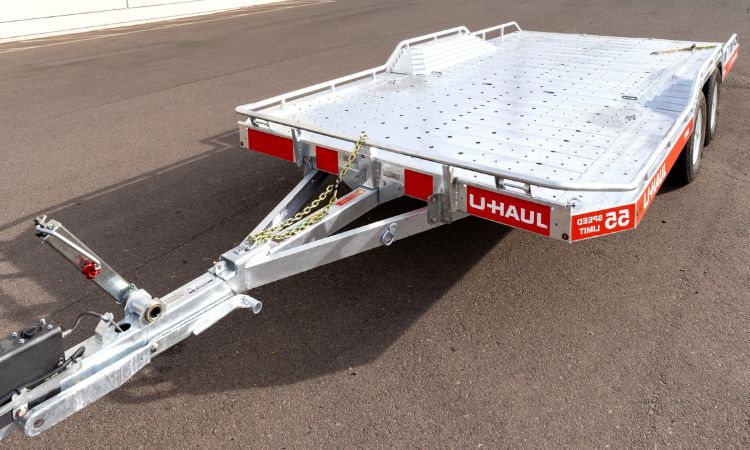
How Much Does a U-Haul Car Trailer Weigh?
Understanding the weight of a U-Haul car trailer is critical when planning your vehicle transport. The weight of the trailer directly affects the towing vehicle’s load capacity, fuel consumption, and safety.
Here’s a detailed breakdown of the weight for both types of U-Haul car trailers:
Auto Transport (Full Trailer):
- Empty Weight: 2,210 pounds (1,002 kg)
- Gross Vehicle Weight Rating (GVWR): 7,500 pounds (3,402 kg)
- Maximum Load Capacity: 5,290 pounds (2,398 kg)
This means that the Auto Transport trailer weighs 2,210 pounds (1,002 kg) when empty. When fully loaded with a vehicle, the weight can reach up to 7,500 pounds (3,402 kg), depending on the weight of the vehicle being transported.
Tow Dolly:
- Empty Weight: 650 pounds (295 kg)
- GVWR: 3,500 pounds (1,588 kg)
- Maximum Load Capacity: 2,850 pounds (1,292 kg)
The Tow Dolly is much lighter than the Auto Transport. Its empty weight is only 650 pounds (295 kg), with a maximum capacity of 3,500 pounds (1,588 kg) when fully loaded. This makes it an excellent option for lighter vehicles but limits the types of vehicles it can safely transport.
These weights are crucial when determining whether your towing vehicle can handle the load. A heavier trailer requires a more powerful towing vehicle, and it can also affect fuel efficiency. Lighter trailers, on the other hand, are generally more fuel-efficient but may not be suitable for heavier vehicles.
Comparison Table: U-Haul Car Trailer Weights
Here is a detailed comparison table of the different U-Haul car trailers, showing their weight, capacity, price range, and other important features:
| Trailer Type | Empty Weight (lbs) | GVWR (lbs) | Max Load Capacity (lbs) | Price Range (USD/day) | Max Vehicle Length (ft) | Towing Compatibility | Key Features |
|---|---|---|---|---|---|---|---|
| Auto Transport | 2,210 | 7,500 | 5,290 | $50–$100 | 16 | Heavy-duty vehicles | Full vehicle lift, braking system |
| Tow Dolly | 650 | 3,500 | 2,850 | $30–$60 | 10 | Front-wheel drive cars | Lighter, easier to maneuver |
| Auto Transport 2020+ | 2,150 | 7,300 | 5,150 | $55–$110 | 16 | Heavy-duty vehicles | Enhanced ramp design, safety features |
| Tow Dolly 2020+ | 600 | 3,400 | 2,800 | $35–$65 | 9 | Front-wheel drive cars | Updated tie-down system, lower weight |
Note: Prices in the table are approximate and may vary by location, duration of rental, and trailer availability.
Basics of a U-Haul Car Trailer Weight
Understanding the various components that make up the weight of a U-Haul car trailer is essential for ensuring that you tow the trailer safely, within capacity limits, and in compliance with legal regulations. The three critical weight classifications for U-Haul car trailers are Curb Weight, Gross Vehicle Weight Rating (GVWR), and Payload Capacity. Each of these weight metrics plays a crucial role in determining how much weight the trailer can safely carry and how it impacts your towing vehicle’s performance.
Curb Weight
Curb weight refers to the weight of the U-Haul car trailer when it is empty, without any load. It includes all of the trailer’s structural and operational components, such as the frame, axles, tires, braking systems, and other built-in features. However, curb weight does not account for the weight of the vehicle or any other cargo the trailer may be hauling.
The curb weight is an essential factor because it helps you understand how heavy the trailer is on its own. For example, the Auto Transport trailer from U-Haul has an empty curb weight of about 2,210 pounds (1,002 kg), while a Tow Dolly weighs significantly less at 650 pounds (295 kg). This base weight provides insight into how much of the towing vehicle’s load capacity will be used just by the trailer itself.
The curb weight of the trailer impacts how your towing vehicle handles the load. A heavier trailer will place more strain on the towing vehicle’s engine, suspension, and braking system, making it essential to match the trailer’s curb weight with the capacity of your vehicle. A mismatch in weight can lead to handling issues, decreased fuel efficiency, and increased risk of accidents.
Gross Vehicle Weight Rating (GVWR)
The Gross Vehicle Weight Rating (GVWR) is the maximum weight that the trailer is rated to safely handle, including its own curb weight and the weight of any cargo or vehicle it may carry. This rating is crucial because it tells you the maximum combined weight of the trailer and its load. The GVWR is an important figure for safe towing, as exceeding it can compromise the trailer’s structural integrity and lead to dangerous driving conditions.
For example, the Auto Transport trailer has a GVWR of 7,500 pounds (3,402 kg). This means that the combined weight of the trailer and the vehicle it is carrying should not exceed 7,500 pounds. The GVWR includes the weight of the trailer itself and any load, so when planning a move, it’s essential to ensure the combined weight of the trailer and vehicle being towed does not exceed this rating.
The GVWR also serves as a reference point for law enforcement officers to ensure that trailers are not overloaded and that they meet safety standards. If you exceed the GVWR, you risk damaging the trailer and putting your vehicle and others on the road in danger. The GVWR is set by the manufacturer, who tests the trailer’s design to ensure it can safely handle the specified load.
Payload Capacity
The Payload Capacity of a U-Haul car trailer is the maximum amount of weight it can safely carry, excluding its own curb weight. It is calculated by subtracting the curb weight from the GVWR. The result is the amount of weight the trailer can safely transport without exceeding the maximum rated capacity.
For instance, if the GVWR of the Auto Transport trailer is 7,500 pounds (3,402 kg) and the curb weight is 2,210 pounds (1,002 kg), the payload capacity is 5,290 pounds (2,398 kg). This means the trailer can carry up to 5,290 pounds (2,398 kg) of cargo, which includes the vehicle being towed. The payload capacity is a critical figure when planning a move, as it helps you determine if the trailer can safely carry the weight of your vehicle.
Understanding the payload capacity helps ensure you do not overload the trailer, which could lead to mechanical issues, including excessive wear on the tires, suspension, or axles. It’s also essential for safe driving because an overloaded trailer can affect braking distance, maneuverability, and stability. An overloaded trailer can cause swaying or fishtailing behind the towing vehicle, especially at higher speeds or when encountering crosswinds.
Factors Influencing a U-Haul Car Trailer’s Weight
When you’re selecting a U-Haul car trailer, it’s important to understand the various factors that affect its weight. The weight of a trailer plays a crucial role in the towing experience, affecting safety, fuel efficiency, and overall vehicle compatibility. Several components contribute to the weight of a U-Haul car trailer, including construction materials, design features, the model year, and the type of trailer. In this section, we’ll take a detailed look at these factors to help you better understand how they influence the trailer’s weight and what that means for your towing experience.
1. Construction Material
The materials used in the construction of a U-Haul car trailer significantly influence its weight. Construction materials determine not only the durability and strength of the trailer but also its overall mass. Traditionally, steel has been the go-to material for constructing trailers due to its strength, durability, and ability to withstand the heavy loads associated with towing. Steel, however, is quite heavy, and its use in trailer construction naturally increases the overall weight of the trailer.
While steel offers excellent structural integrity, it also means that the trailer can become significantly heavier. For instance, U-Haul’s Auto Transport model, which is designed to carry larger vehicles, has a curb weight of 2,210 pounds (1,002 kg), largely due to the steel frame and other metal components.
On the other hand, newer materials such as aluminum and composites are becoming more common in trailer construction. These materials are significantly lighter than steel but still offer the necessary strength to support the weight of the vehicle being transported. Aluminum trailers are particularly popular in the industry because they reduce the overall weight without compromising the trailer’s structural integrity. The use of lighter materials helps improve towing efficiency by reducing the load on the towing vehicle and improving fuel economy.
However, lighter materials like aluminum and composite materials typically come at a higher price point due to the increased cost of production. Despite the higher upfront cost, trailers made from lighter materials provide long-term benefits in terms of reduced fuel consumption and easier handling. U-Haul’s trailers, while not entirely made of aluminum, have increasingly adopted materials that help reduce the weight without sacrificing durability.
2. Design Features
The design features of a U-Haul car trailer can also significantly contribute to its overall weight. The complexity and number of features in a trailer can make a big difference in its total mass. These features are essential for ensuring the trailer performs its function safely and effectively but do come with added weight.
Some of the key design features that influence a trailer’s weight include:
- Ramps: Ramps are an essential component of car trailers, allowing easy loading and unloading of vehicles. Ramps are typically made of steel or aluminum, and their weight can add to the overall trailer mass. The length and size of the ramps also play a role in determining how much they add to the trailer’s total weight.
- Braking System: Many U-Haul car trailers come equipped with a braking system, which adds a layer of safety, especially for longer hauls and heavier loads. The braking system often consists of additional components such as brakes, axles, and related equipment, which can significantly increase the trailer’s weight.
- Tie-Down Points: The trailer must be equipped with secure tie-down points to ensure that the vehicle being transported stays in place during the journey. These tie-down points can add weight to the trailer due to the hardware involved, such as reinforced tie-down rings, brackets, and fasteners.
- Reinforced Frame: The frame of the trailer is essential for carrying the load and maintaining its structural integrity during transport. Reinforced frames are often used for trailers designed to carry larger vehicles and heavier loads, adding to the overall mass of the trailer.
While these features enhance safety and usability, they do contribute to the total weight. As such, trailers with more advanced or reinforced features tend to weigh more than basic models, but they offer superior stability and protection for the vehicle being transported.
3. Model Year
The model year of the trailer can also impact its weight. Just as cars and other vehicles undergo improvements in design and material use over time, so do U-Haul car trailers. Newer models often incorporate lighter materials, advanced construction techniques, and updated features, which can reduce the overall weight of the trailer without compromising its load-carrying capacity.
Manufacturers are continually working to improve the design and materials used in trailer construction to enhance towing efficiency, reduce fuel consumption, and improve ease of handling. For example, newer U-Haul car trailers may use more advanced composite materials, which are lighter than older steel models but still offer comparable strength. These changes not only help reduce the weight of the trailer but can also improve towing performance by making the trailer easier to maneuver.
While the reduction in weight from year to year might not always be drastic, the combination of lighter materials, improved aerodynamics, and more efficient design often results in a trailer that is both easier to tow and more fuel-efficient. These incremental changes can make a noticeable difference, especially on long-distance journeys.
4. Trailer Type
Finally, the type of trailer you choose plays a critical role in determining its weight. There are two primary types of U-Haul car trailers: Auto Transport and Tow Dolly. Each type serves different purposes and is designed to transport different kinds of vehicles, which in turn affects the overall weight.
- Auto Transport (Full Trailer): The Auto Transport is designed to carry larger, heavier vehicles, such as SUVs, trucks, and luxury cars. As a full trailer, it is built to lift all four wheels of the vehicle off the ground. This trailer is generally heavier because it is designed to provide more support, stability, and strength for heavier loads. The Auto Transport trailer, for instance, weighs 2,210 pounds (1,002 kg) when empty, and its GVWR (Gross Vehicle Weight Rating) is 7,500 pounds (3,402 kg), allowing it to carry up to 5,290 pounds (2,398 kg) of vehicle load.
- Tow Dolly: In contrast, the Tow Dolly is much lighter because it is designed for smaller, front-wheel-drive vehicles. The Tow Dolly lifts only the front wheels of the towed vehicle off the ground, making it suitable for lighter vehicles. The Tow Dolly typically weighs around 650 pounds (295 kg) and has a lower GVWR of 3,500 pounds (1,588 kg), with a maximum load capacity of 2,850 pounds (1,292 kg). This lighter weight makes the Tow Dolly a more economical choice for those needing to tow smaller vehicles over shorter distances.
The Auto Transport is more robust and suited for larger vehicles, making it heavier overall, while the Tow Dolly is lighter and more cost-effective but limited in terms of vehicle compatibility. The type of trailer you choose depends largely on the weight of the vehicle you need to transport and your specific towing needs.
Why a U-Haul Car Trailer’s Weight Matters
The weight of a U-Haul car trailer has a significant impact on various aspects of your transport experience, including:
1. Towing Vehicle Compatibility:
Before renting a trailer, it’s essential to ensure that your towing vehicle can handle the combined weight of the trailer and the vehicle being transported. Overloading your towing vehicle can lead to mechanical failures, reduced braking efficiency, and an overall unsafe towing experience.
2. Fuel Efficiency:
A heavier trailer requires more power to tow, which can reduce the fuel efficiency of your towing vehicle. Lighter trailers, such as Tow Dollies, are more fuel-efficient and can help reduce the overall cost of your journey.
3. Safety:
Proper weight distribution and trailer weight play a crucial role in maintaining the safety of the tow. Heavier trailers require more attention to braking and handling, especially on long descents or uneven terrain. Matching the trailer weight with the appropriate towing vehicle is crucial for maintaining control and avoiding accidents.
How Much Does a U-Haul Car Trailer Cost?
The cost of renting a U-Haul car trailer can vary based on several factors, including the type of trailer, location, rental duration, and additional services. Generally speaking, here’s a breakdown of rental costs:
- Auto Transport: Costs between $50 to $100 per day depending on location and availability. This option is ideal for larger or heavier vehicles and is often used for long-distance moves.
- Tow Dolly: Rental costs for a Tow Dolly typically range from $30 to $60 per day. This is a more economical option for smaller vehicles, especially those with front-wheel drive.
Keep in mind that additional charges may apply for mileage, insurance, and other optional services.
How Much Does It Cost to Rent a U-Haul Car Trailer?
In addition to the base rental cost, U-Haul may charge for mileage, which typically ranges from $0.50 to $1.00 per mile, depending on the location and rental terms. Other fees could include charges for insurance, damage waivers, or additional accessories like loading ramps or extra tie-downs.
How Much Does a U-Haul Car Trailer Tire Weigh?
Each tire on a U-Haul car trailer typically weighs between 50 to 70 pounds (23 to 32 kg), depending on the size and load capacity of the tire. This weight contributes to the overall weight of the trailer and impacts the towing dynamics.
How Much Does a U-Haul Car Trailer Tire Cost?
The cost of replacing a tire on a U-Haul car trailer typically ranges from $100 to $200 per tire, depending on the tire size, type, and location of the trailer. Specialty tires for heavier-duty trailers may cost more.
How Much Fuel Does a U-Haul Car Trailer Use?
While the U-Haul car trailer itself does not consume fuel directly, towing a trailer will impact the fuel consumption of your towing vehicle. Generally speaking, towing a trailer can reduce fuel efficiency by 10 to 15%. The exact reduction will depend on the weight of the trailer, the vehicle being towed, and the terrain.
How Fast Can a U-Haul Car Trailer Go?
The maximum speed at which you can safely tow a U-Haul car trailer depends on several factors, including the towing vehicle, trailer weight, and road conditions. As a general rule, 55 mph (88 km/h) is the recommended speed for towing a U-Haul car trailer, particularly on highways or in areas with high winds or heavy traffic.
How Tall Is a U-Haul Car Trailer?
The typical height of a U-Haul car trailer is approximately 2 feet 2 inches (66 cm), although this may vary slightly depending on the specific model year and design.
How Wide Is a U-Haul Car Trailer?
Most U-Haul car trailers have a width of approximately 8 feet (244 cm). This width is standard for most models and ensures that a wide variety of vehicles can be safely transported without exceeding legal width limits.
Dimensions of a U-Haul Car Trailer
| Trailer Type | Length (ft) | Width (ft) | Height (ft) | Deck Height (in) | Tire Size (in) |
|---|---|---|---|---|---|
| Auto Transport | 16 | 8 | 2.2 | 19 | 15 |
| Tow Dolly | 10 | 8 | 2.2 | 12 | 14 |
Conclusion
Understanding the weight of a U-Haul car trailer is essential for ensuring safe and efficient vehicle transport. Whether you’re moving a family car, an SUV, or a light truck, knowing the exact weight of the trailer helps you choose the right towing vehicle and ensures you comply with safety regulations. By understanding the weight, towing capacity, and associated costs of renting a U-Haul car trailer, you can make a more informed decision and ensure a smoother transport experience.
Fun Facts
- Weight Distribution: Auto Transport trailers are heavier due to the ability to lift the entire vehicle off the ground.
- Lighter Tow Dolly: Tow dollies are significantly lighter, making them more fuel-efficient and easier to maneuver in tight spaces.
- Tire Weight: Each U-Haul car trailer tire weighs between 50 to 70 pounds (23 to 32 kg), contributing to the overall weight of the trailer.